Self-Employed Mortgages · Calgary & Alberta

Self-Employed Mortgage in Calgary — You Earn It, We Can Prove It

Your bank uses your tax return income — the number you've deliberately kept low. A broker accesses lenders who look at gross revenue, bank statements, and real cash flow. If your bank said no, that's one answer. Not the market's.

Get Pre-Approved → We find lenders who understand how you actually earn.
50+
Lenders
$0
Broker Fees
5★
Google Rated
Licensed
in Alberta

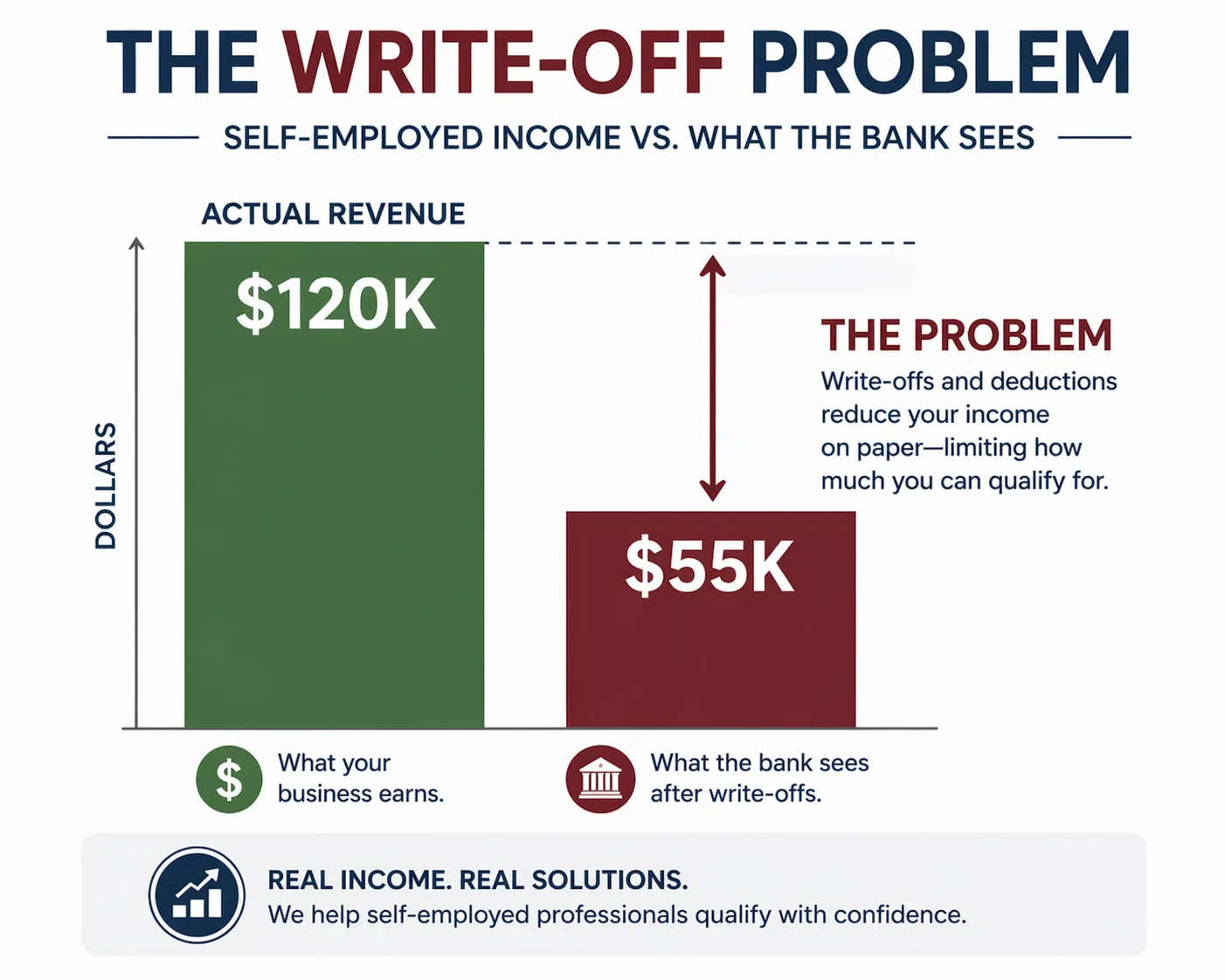
Can self-employed people get a mortgage in Calgary? Yes — absolutely. The majority of self-employed Calgarians who were turned down by their bank qualify with a B lender, through a stated income approach, or via gross revenue qualification. Banks use your NOA net income figure — a number that's often intentionally minimized to reduce taxes. A broker accesses 50+ lenders who evaluate your actual earning capacity. Being self-employed isn't the disqualifier. Applying to the wrong lender is.

Why Banks Reject Self-Employed Mortgage Applications

Banks use a rigid qualification model that was designed for T4 employees. Self-employed income — by definition — doesn't fit that model.

⚠️

The write-off trap: The better your accountant, the lower your declared net income on your Notice of Assessment (NOA). The lower your NOA income, the less mortgage you qualify for at a bank. You're being penalized for good tax planning.

The Specific Problem for Each Business Type

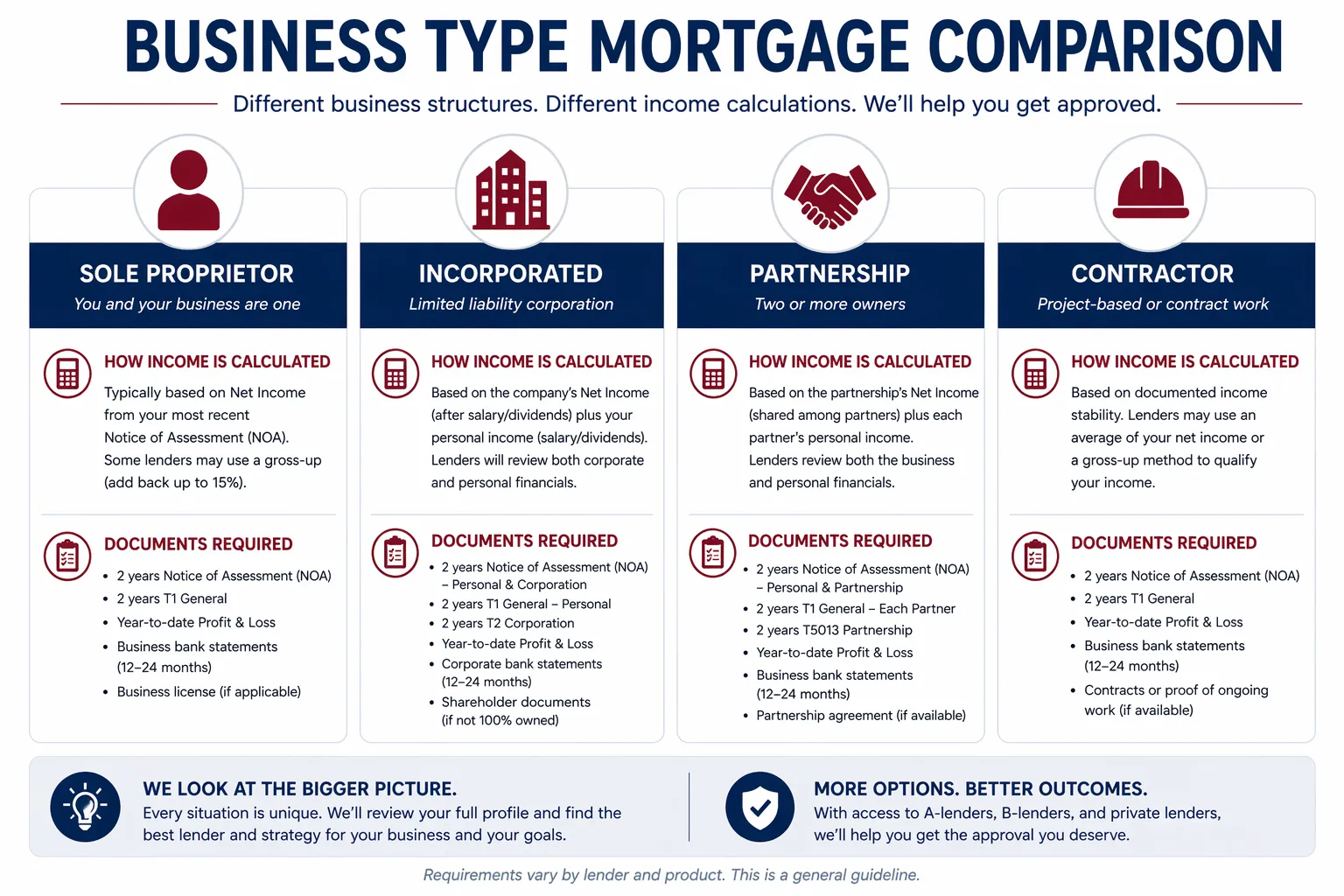
Sole Proprietors & Freelancers

Your income is on Schedule C of your T1 general. After business expenses, the net number banks use may be a fraction of what you actually earn. Gross-up strategies and B lender options exist specifically for this profile.

Incorporated Business Owners

Banks look at salary drawn and dividends — not retained earnings in the corporation. If you leave income inside the corporation for tax efficiency, you look income-poor on paper even with a thriving business.

Contractors (T4A Income)

Treated similarly to self-employed by most lenders. Some want confirmation of ongoing contracts. Two years of T4A history opens A lender doors — but one year, or variable contracts, often requires a B lender approach.

Gig & Platform Workers

An emerging category. Some lenders use bank statement income averaging. Strong cash flow through accounts like Uber, Airbnb, or Etsy can support qualification — but typically requires a broker who knows which lenders accept this income type.

The broker's role:

A bank shows you one door and one qualification method. A broker accesses 50+ lenders across A, B, and alternative tiers — each with different income assessment methods. The broker knows before you apply which lenders accept stated income, which allow add-backs, and which use bank statement cash flow. That knowledge prevents wasted applications and unnecessary credit hits.

Who This Page Is For

✓ This is for you if:

  • You're self-employed and want to buy a home in Calgary
  • Your bank said no or you're worried they will
  • You've been self-employed for 2+ years (strong path)
  • You've been self-employed 1–2 years (options exist)
  • You're incorporated and your declared income looks low
  • You're a contractor, consultant, or freelancer

Honest reality — when it genuinely is harder:

  • Under 1 year self-employed — very limited options, mainly private lenders at high rates
  • Active CRA tax debt — most lenders require this cleared before approval
  • Business failing or declining revenue trend — lenders see this in your financials
  • No supporting business documentation at all

Even in harder situations, talking to a broker first costs nothing and clarifies what's actually possible vs what your bank told you.

How Self-Employed Mortgage Qualification Actually Works

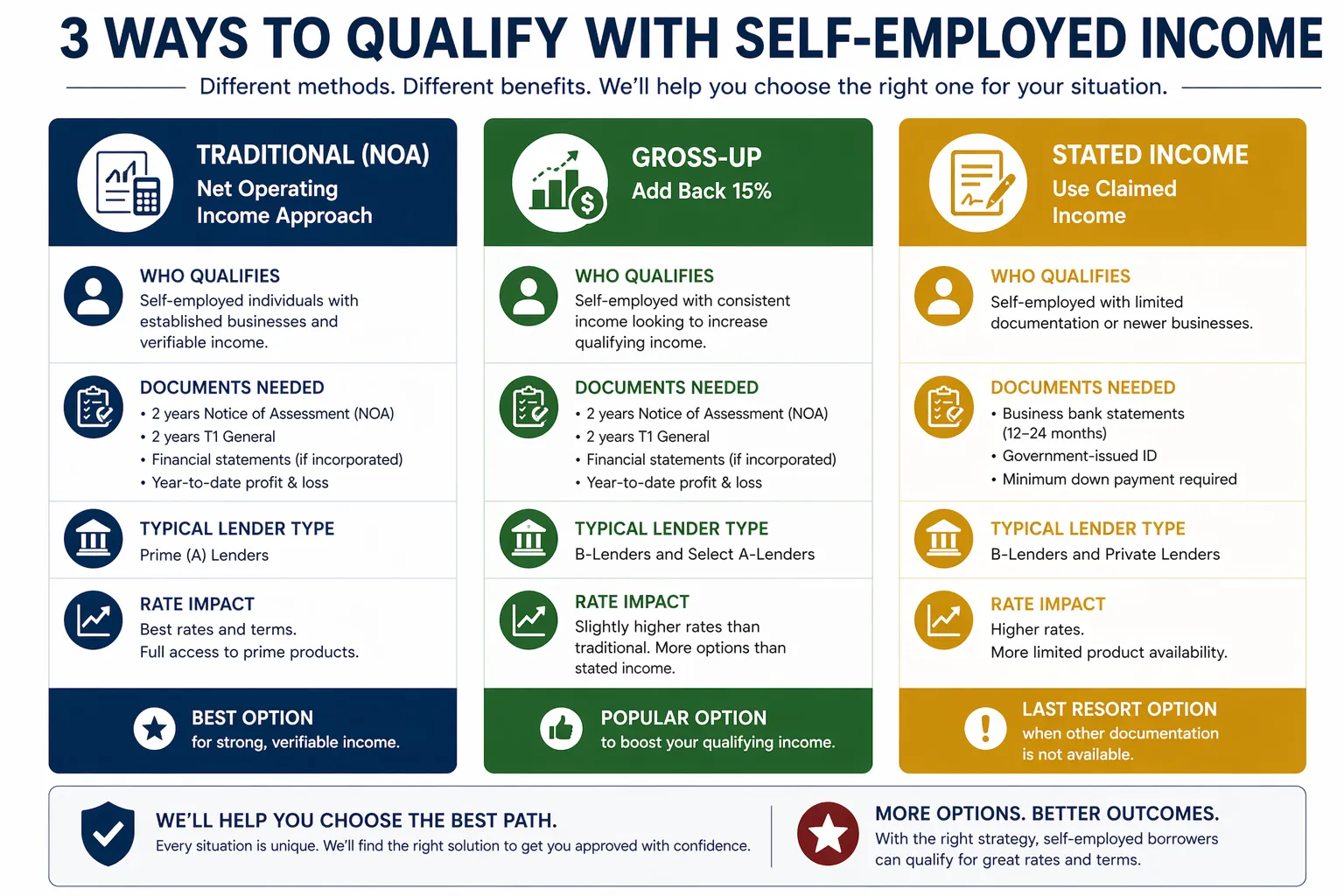
There are three qualification methods lenders use. Most banks only use the first one. A broker accesses all three.

1
Traditional NOA Qualification (A Lenders) Banks & major lenders

Uses your 2-year average net income from your T1 general and Notice of Assessment. Line 15000 minus all business expenses. Stress tested at the qualifying rate.

  • Best rates — but strictest qualification
  • Requires 2 years of strong declared income
  • 680+ credit score typically required
  • Works if your NOA income is strong after write-offs
2
Gross-Up / Add-Back Approach Broker-accessed A/B lenders

Some lenders allow non-cash expenses — Capital Cost Allowance (CCA), depreciation, vehicle allowances — to be added back to your declared income to produce a higher qualifying number.

  • CMHC's Business for Self program allows 15% gross-up on gross income
  • Increases qualifying income without changing your tax return
  • Available only through brokers — banks rarely offer this internally
  • Effective for incorporated owners and sole proprietors with high write-offs
3
Stated Income / Bank Statement Qualification (B Lenders) Bridge strategy

The lender qualifies you on stated business income supported by bank statements, GST/HST returns, and business registration — rather than your NOA figure alone.

  • Rates 0.5–1.5% above A lender rates
  • Accessible without 2 years of strong NOA income
  • B lenders: Home Trust, Equitable Bank, Bridgewater, CMLS
  • Bridge strategy: qualify now, build track record, refinance to A lender at renewal

The path most self-employed borrowers take: Qualify with a B lender using stated income today. Build 2 years of stronger income documentation during the term. Refinance to an A lender at renewal for best rates. The temporary rate premium is the cost of getting into homeownership sooner — and it's rarely as large as people assume.

Definition

What Is a Stated Income Mortgage?

A stated income mortgage is a product offered by B lenders where the borrower states their business income and supports it with documentation — bank statements, GST/HST returns, and business registration — rather than relying solely on the NOA net income figure. The lender cross-references the stated income against business documentation and industry benchmarks to assess plausibility. Rates are typically 0.5–1.5% above A lender rates. These are not "liar loans" — full documentation is still required. The difference is which income figure is used as the qualifying number.

A Lender vs B Lender vs Private — Which One Applies to You?

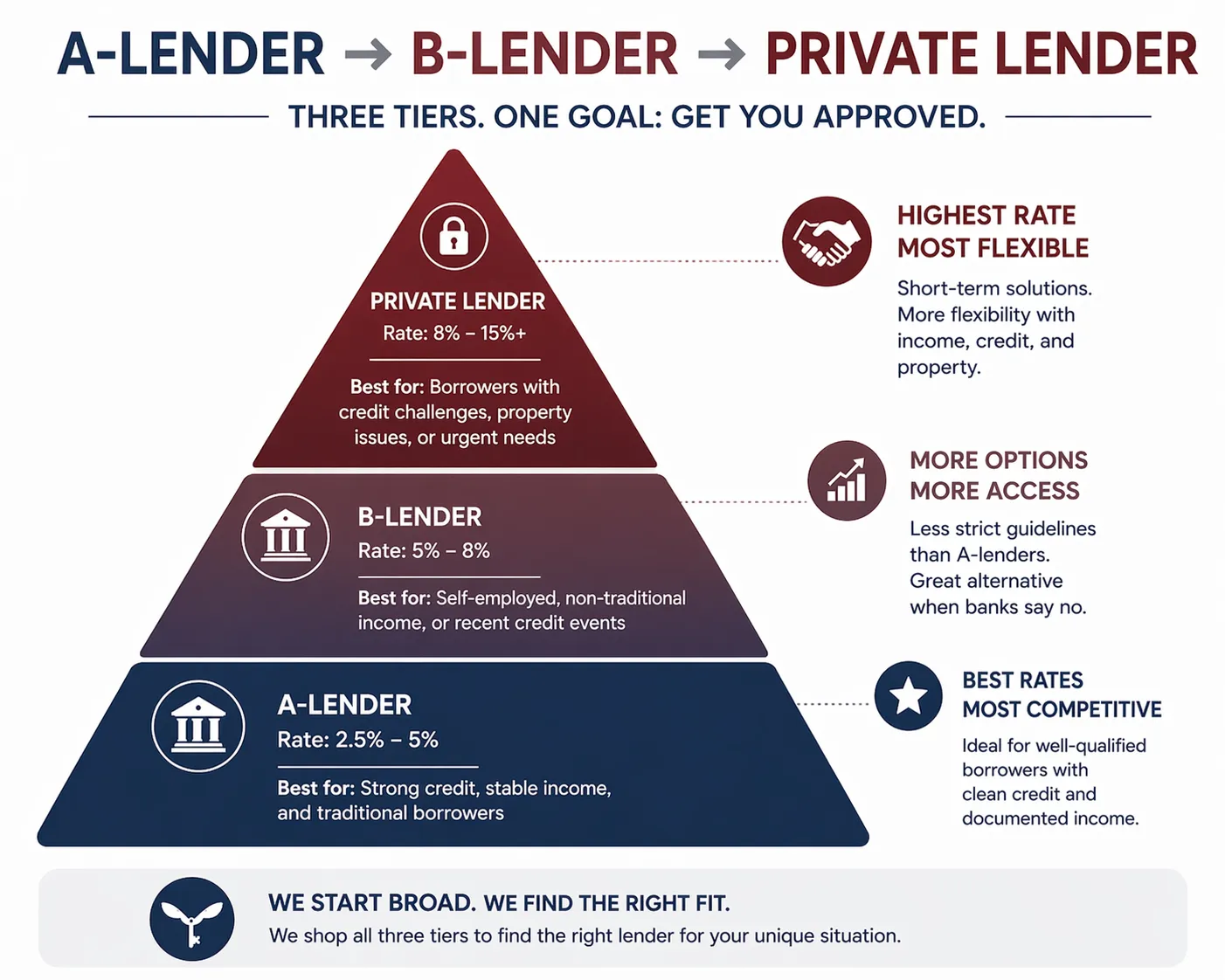
Three tiers. You're not limited to the first one your bank offers.

A Lenders

Best rates

Banks, credit unions, major monoline lenders

  • Current rates ~4–5% for qualified borrowers
  • 2 years strong declared income (NOA) required
  • 680+ credit score typically
  • CMHC insured mortgages available under 20% down

Goal: reach A lender at renewal if you start at B lender

B Lenders

Bridge strategy

Home Trust, Equitable Bank, Bridgewater, CMLS, Haventree

  • Rates typically A lender + 0.5–1.5%
  • Accept stated income with supporting documentation
  • Flexible on 2-year rule for some situations
  • 620+ credit score typically required
  • 20% down payment usually required

Most self-employed Calgary borrowers qualify here first — it works well

Private Lenders

Last resort — needs exit plan

Mortgage Investment Corporations (MICs), individual investors

  • Rates 6–12%+ currently
  • Minimal income documentation — asset-based
  • Short terms (6 months to 2 years typically)
  • Exit strategy is non-negotiable before signing
Better than not buying — but only with a clear path to B or A lender at renewal

Bank said no? Let's find out what's actually possible.

Free consultation — tell us your situation, we'll map your options across 50+ lenders.

Book a Free Consultation →

How a Self-Employed Mortgage Works With Maple Key

The process is straightforward. The expertise is in knowing which lender to approach — and how to present your income.

Self-Employed Mortgage Options — Side by Side

How the three lender tiers compare for self-employed borrowers in Calgary.

Lender Type Income Method Rate Range (2026) Best For Broker Required?
A Lender
Banks, credit unions, monolines
2-yr average NOA net income ~4–5% 2+ yrs strong declared income, 680+ credit Recommended — broker-exclusive rates available
A Lender (Gross-Up)
Broker-accessed lenders only
NOA + add-backs (CCA, depreciation) ~4–5.5% High write-offs but strong gross revenue Yes — not available direct to public
B Lender
Home Trust, Equitable, Bridgewater
Stated income + bank statements + GST ~5.5–7% 1–2 yrs self-employed, low NOA, flexible docs Yes — B lenders are broker-only access
Private Lender
MICs, individual investors
Asset-based — minimal income docs 6–12%+ Under 1 yr, significant credit issues, last resort Yes — exit plan required

B lenders are fully regulated Canadian financial institutions — not payday lenders or loan sharks. Home Trust, Equitable Bank, and Bridgewater are all federally or provincially regulated. Their rates are higher because they accept more income documentation flexibility — not because they're less legitimate.

Documents You'll Need — By Lender Type

B lenders require less paperwork than banks in some respects — and more flexibility on income sources.

📄 For A Lender Qualification

  • 2 years T1 generals (full tax returns)
  • 2 years Notices of Assessment (from CRA My Account)
  • Business registration or articles of incorporation
  • 3 months business bank statements
  • Current year income confirmation (if mid-year)
  • GST/HST registration number

📄 For B Lender / Stated Income

  • 6–12 months business bank statements
  • Business license or registration
  • GST/HST returns showing business revenue
  • Accountant letter (sometimes required)
  • Proof of business (website, invoices, contracts)
  • Less emphasis on NOA — more on cash flow
💡

Get your NOAs from CRA My Account. Log in at canada.ca/my-cra-account → Tax Returns → Return and assessment detail → Download the NOA PDF. This takes about 10 minutes and is the most commonly missing document in self-employed applications.

What Self-Employed Calgarians Get Wrong About Mortgages

These are the patterns that show up consistently — and every one of them has a better solution.

What income will a lender actually use for your application?

Use our mortgage affordability calculator to run the numbers with your real income structure.

Use the Affordability Calculator →

Self-Employed Mortgage in Calgary — Complete Summary

  • Self-employed Calgarians can get a mortgage — the key is finding the right lender and the right income qualification method for their specific situation.
  • Banks use NOA net income, which is often deliberately minimized through tax write-offs. B lenders and alternative lenders use stated income, bank statements, and gross revenue — producing a much more accurate picture of earning capacity.
  • The three qualification methods are: (1) traditional NOA qualification, (2) gross-up/add-back approach, and (3) stated income with bank statement support. A broker determines which method produces the best result for each borrower.
  • A lenders offer the best rates but require 2 years of strong declared income. B lenders are 0.5–1.5% higher and accept more flexible documentation. The typical strategy is B lender now, A lender at renewal after building a stronger income track record.
  • Documents needed: 2 years T1 generals and NOAs for A lenders; 6–12 months bank statements and GST returns for B lenders. B lenders require less paperwork in some respects.
  • Multiple bank applications damage your credit score — a broker submits one application to the right lender with the right income qualification method, protecting your credit throughout the process.
  • The mortgage broker service is completely free — the lender pays a finder's fee when your mortgage closes. You pay nothing, regardless of which lender tier you end up with.
  • Start the process 60–90 days before you need to make an offer. Self-employed qualification requires more preparation time than T4 qualification — a pre-approval prevents being caught unprepared when the right property appears.

Self-Employed Mortgage Calgary — Frequently Asked Questions

Direct answers with no contact form requirement.

Yes. The majority of self-employed Calgarians who were turned down by their bank qualify with a B lender, through a stated income approach, or via a gross revenue qualification method.

Banks use your declared NOA net income — often intentionally minimized to reduce taxes. A broker accesses 50+ lenders who evaluate gross revenue, bank statement cash flow, or stated income. Being self-employed is not the disqualifier. Applying to the wrong lender is.

The standard is 2 years of self-employment history for most A lenders. Exceptions exist: if you have strong financials after 1 year and were previously employed in the same field, some lenders will consider your application.

If you're incorporated from a prior T4 position in the same industry, many lenders view that as a career progression rather than a risk. Under 1 year typically means B lender or alternative lender territory at higher rates — with a clear path to A lender at renewal.

It depends on the lender type. A lenders use the 2-year average net income from your T1 general and Notice of Assessment (NOA). Some A lenders allow add-backs for non-cash expenses like Capital Cost Allowance (CCA) and depreciation.

B lenders accept stated income supported by bank statements, GST/HST returns, and business registration. CMHC's Business for Self program allows a 15% gross-up on gross income for insured mortgages with 10% down. A broker determines which method produces the best qualifying income for your situation.

For A lenders: 2 years T1 generals (full tax returns), 2 years Notices of Assessment from CRA My Account, business registration or articles of incorporation, 3 months business bank statements, and current year income confirmation.

For B lenders: 6–12 months business bank statements, business license or registration, GST/HST returns showing revenue, and sometimes an accountant letter. B lenders require less emphasis on NOA figures and more on cash flow documentation.

A stated income mortgage is a product offered by B lenders where you state your business income and support it with documentation — bank statements, GST/HST returns, and business registration — rather than qualifying on your NOA net income figure alone.

The lender cross-references your stated income against your business documentation and industry benchmarks. Full documentation is still required — but the qualifying income figure is the stated gross business income rather than the after-write-off NOA number. Rates are typically 0.5–1.5% above A lender rates.

Not necessarily for A lenders if your income qualifies through traditional methods. For B lenders or stated income mortgages, a minimum of 10–20% down payment is typically required.

A larger down payment can compensate for income documentation challenges — it reduces the lender's risk and improves approval odds. CMHC's Business for Self program accepts 10% down for insured mortgages for qualified self-employed borrowers.

A lenders (banks, credit unions, major monolines) have the strictest qualification criteria and the best rates — they require 2 years of strong declared income from your NOA. B lenders (Home Trust, Equitable Bank, Bridgewater, CMLS) are regulated Canadian financial institutions with more flexible income documentation, at rates 0.5–1.5% higher.

B lenders are designed as a bridge — most self-employed borrowers start with a B lender, then refinance to an A lender at renewal after building a stronger income record. See mortgage renewal Calgary for how that transition works.

Not if you qualify through an A lender — you receive the same rates as any borrower. If you qualify through a B lender or stated income route, rates are typically 0.5–1.5% above current A lender rates.

This is a temporary position. The standard strategy: qualify at B lender now, build a 2-year income track record, refinance to A lender at renewal. The rate premium is the cost of getting into homeownership sooner — and the equity built during that period partially offsets it.

Yes. Incorporated business owners qualify using salary drawn from the corporation, dividends, or a combination of both. Salary drawn is the cleanest income source for qualification purposes. Dividends are usable but require 2 consistent years at most lenders.

Retained earnings inside the corporation generally don't count as qualifying income unless you can demonstrate access to those funds. An accountant and broker working together can optimize your income structure before you apply — sometimes restructuring how you draw income produces significantly better qualification numbers without changing your overall tax position.

Yes. Mortgage brokers are paid a finder's fee by the lender when your mortgage closes — typically 0.5–1.2% of the mortgage amount. You pay nothing. This is true across A lenders, B lenders, and most alternative lenders.

Maple Key Mortgages charges no upfront fees and no fees at closing for self-employed mortgage services. The rate you receive through a broker is the same as or better than going directly to a lender — brokers bring volume, lenders offer broker-exclusive rates in return.

Related Mortgage Services in Calgary

Other situations we handle across Alberta — each free to clients.

Self-Employed in Calgary? Let's Find Your Path to Approval.

A bank shows you one door. A broker opens fifty. Free consultation, no obligation. 5-star rated and licensed in Alberta.

Get Pre-Approved → We find lenders who understand how you actually earn.
Book a Free Consultation Tell us your situation — we'll tell you what's possible.