A bank rejection is one lender's answer — not the market's. B lenders and private lenders in Calgary work with credit scores below 600, past bankruptcies, consumer proposals, and collections. And there's a clear path back to better rates.
Can you get a mortgage with bad credit in Calgary? Yes. A bank rejection is not a final answer — it's one lender's answer. B lenders and private lenders in Calgary approve borrowers with credit scores below 600, past bankruptcies, consumer proposals, missed payments, and collections. They assess the full financial picture — income, equity, down payment, and the reason behind the credit history — not just a credit score from Equifax or TransUnion. Most Calgarians with damaged credit who talk to a broker discover they have more options than they expected.
Banks use a rigid qualification model with hard credit score cutoffs. Below the cutoff, the answer is no — with no explanation of alternatives.
Your bank isn't the whole lending market. Banks are A lenders — they serve borrowers who fit a narrow qualification profile. B lenders and private lenders exist specifically for borrowers the banks turn away. They're regulated, legitimate, and used by thousands of Calgarians every year.
A broker translates your full financial story into the language that gets the right lender to say yes — and prevents a wasted application and credit hit with a lender who would never approve you.
Even in these situations, a broker can map the path forward — what needs to happen first and how long it realistically takes.
There is no single minimum — it depends entirely on the lender type, your down payment, and your full financial picture.
Credit score is one factor — not the only one. Income stability, down payment size, and the story behind the credit damage all affect your options. A 580 credit score from a medical emergency with stable employment and 20% down is a very different application than a 580 from ongoing missed payments with no income documentation.
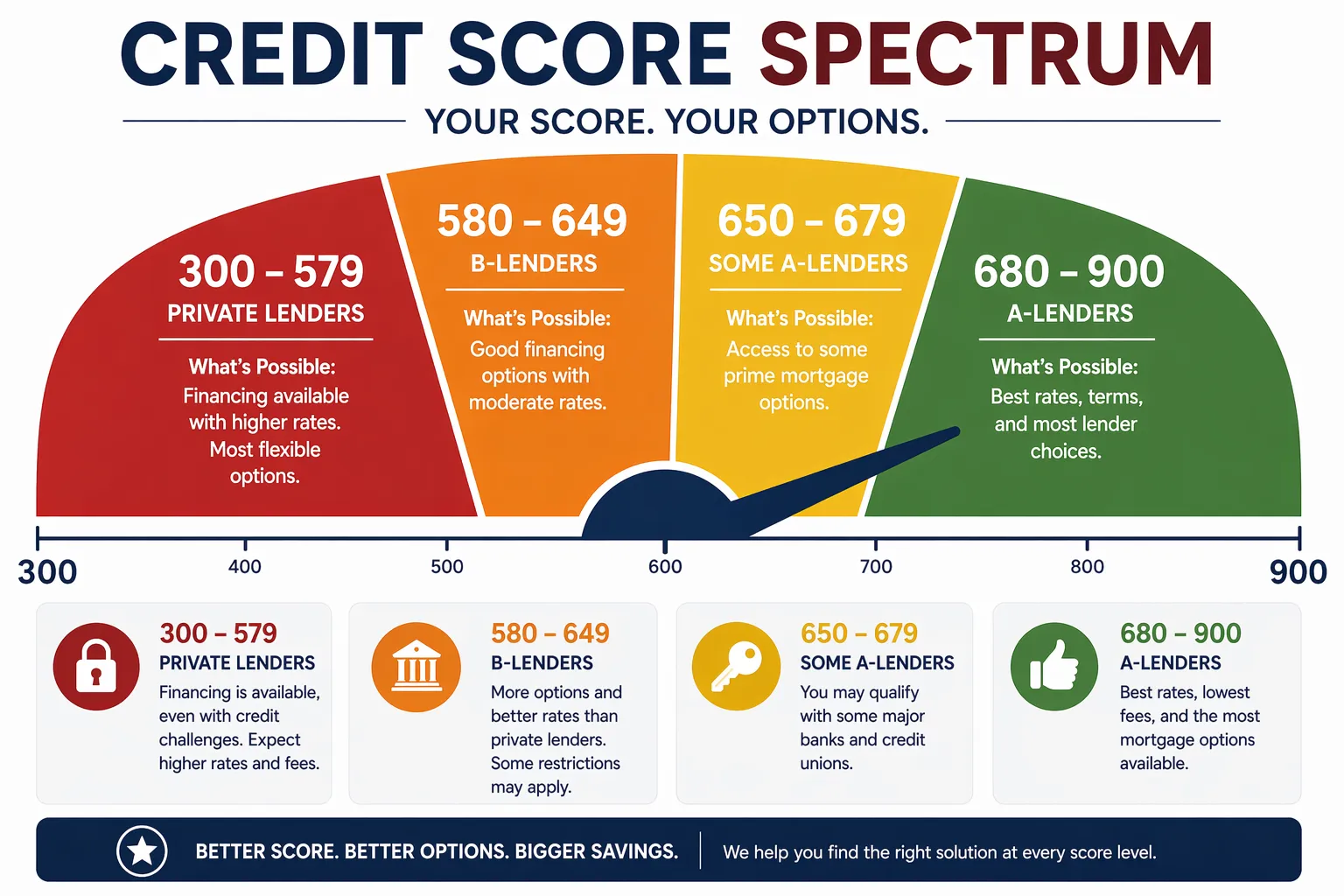
Three tiers. Each with a different qualification threshold, rate, and role in your path to homeownership.
Banks, credit unions, major monolines
Goal: reach A lender at renewal after rebuilding credit
A B lender mortgage is a mortgage issued by a regulated Canadian financial institution — such as Home Trust, Equitable Bank, Bridgewater, or CMLS — with more flexible credit and qualification criteria than major banks. B lenders are not payday lenders or loan sharks. They are supervised by federal or provincial regulators. Their rates are 1–2% above A lender rates. They are designed to be used as a bridge: qualify now at a B lender, rebuild credit during the mortgage term, then refinance to an A lender at renewal for significantly better rates.
Home Trust, Equitable Bank, Bridgewater, CMLS, Haventree
Most bad credit Calgary borrowers qualify here — it works well
Mortgage Investment Corporations (MICs), individual investors
Better than not buying — but only with a clear written exit plan before signing
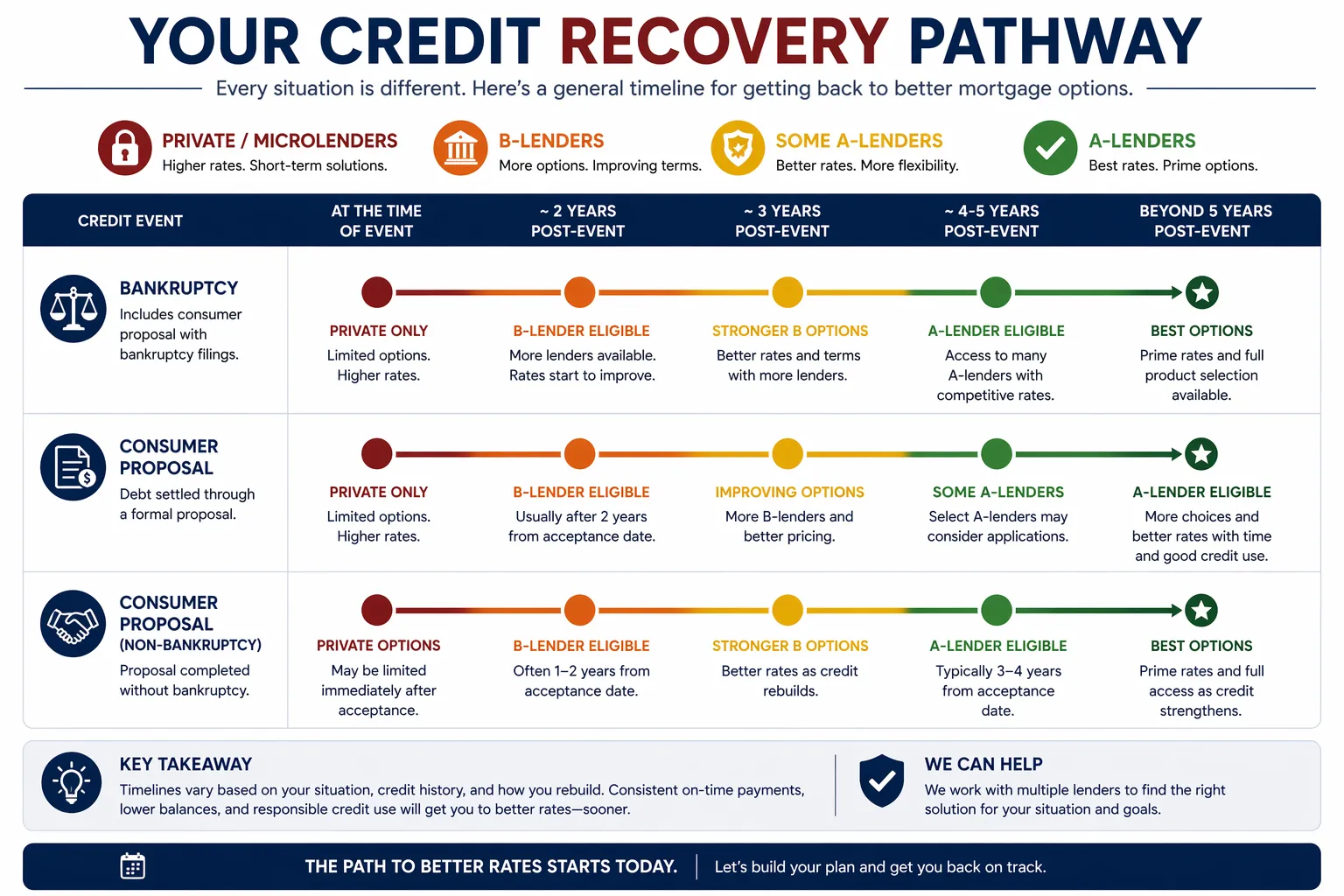
Each credit event has different waiting periods and different lender options. Here's the real picture for Calgary borrowers.
Asset-based lending. Property equity is the primary qualifier. Rates 6–12%+. Short terms. Exit plan essential.
Strong income, 20%+ down, rebuilt credit activity, and a clean explanation letter can support B lender approval. First-time bankruptcy treated more favourably than repeat.
Full A lender access with 24 months of clean credit history, stable income, and a score above 650. The clock starts at discharge, not at filing.
Start rebuilding immediately after discharge with a secured credit card — use it monthly, pay in full. This single action has the most impact on your credit score over time.
Consumer proposals are viewed more favourably than bankruptcy by most lenders. B lenders can often help during or immediately after a consumer proposal with 20% down — full completion is not always required. A lenders typically require 2 years after completion with a 650+ credit score. On-time mortgage payments during a consumer proposal count positively on your Equifax and TransUnion credit files.
Most lenders overlook if the score is otherwise acceptable and the collections are isolated. Time since the event matters significantly.
Must typically be addressed before closing. Some lenders require payment as a condition of approval. A broker knows which lenders have flexibility here.
Most lenders require this cleared — or a formal CRA payment arrangement in place — before approval. No exceptions at most institutions.
The most serious flag for lenders. Requires a detailed written explanation and typically means B lender path with a strong overall application.
Homeownership is the starting point, not the finish line. Here's what the full path looks like with real numbers.
The difference at renewal:
~$550/month saved · $33,000 over the next 5-year term
Based on standard Canadian amortization. Actual results depend on rates at renewal.
Down payment in place. Mortgage structured with renewal strategy built in. Start building equity from day one.
On-time mortgage payments are the single most powerful credit signal. Pay down existing debts. Don't apply for new credit. Target: 640+ before renewal.
With 640+ credit and 24 months of clean mortgage payment history, A lender qualification is typically achievable. Rate drops 1–2%. Monthly savings compound for the full new term. See mortgage renewal Calgary for how this transition works.
No judgment. Just a clear-eyed assessment of what's available and what the path forward looks like.
Share your situation: credit history, income, down payment, and what you're trying to achieve. Everything is confidential. No commitment at any point. Your credit situation is more common than you think.
Income stability, available down payment, existing equity, debt ratios (GDS/TDS), and the reason and timeline of the credit events. Context changes outcomes — the full picture matters.
A lender, B lender, or private — and which specific lenders within each tier are most likely to approve your profile. This prevents wasted applications and unnecessary hard inquiries on your Equifax and TransUnion reports.
Your broker submits to the most appropriate lender. One credit inquiry. No multiple hard pulls. If B lenders are needed, the broker has relationships with Home Trust, Equitable Bank, Bridgewater, CMLS, and Haventree.
The broker builds the path to A lender rates into the structure before you sign anything. Lender pays the broker fee. You pay nothing — at any stage.
A direct comparison of what's available at each lender tier for Calgary borrowers with damaged credit.
| Lender Type | Min. Credit Score | Rate Range (2026) | Best For | Path to A Lender |
|---|---|---|---|---|
| A Lender Banks, credit unions, monolines |
620+ | ~4–5% | Clean recent credit, stable income, standard docs | Already there |
| B Lender Home Trust, Equitable, Bridgewater, CMLS |
560+ | ~6–7.5% | Damaged credit, past events, 20%+ down | Requalify at renewal (1–2 years) |
| Private Lender MICs, individual investors |
No minimum (asset-based) | 6–12%+ | Bankruptcy just discharged, very low score, last resort | B lender at renewal (6–24 months) |
The higher rate at a B lender is temporary — the rate at A lender at renewal is not. On a $500K mortgage, the difference between 7% and 5% is ~$550/month. That savings compounds over every year you hold an A lender mortgage going forward. Starting with a B lender to get into homeownership sooner is often the better financial decision overall.
Free, no-judgment consultation — tell us your situation, we'll map what's possible.
Every one of these has a better solution — and most people don't find out until they talk to a broker.
Getting into homeownership is step one. Here's how to make step two — A lender rates — a realistic outcome within 2 years.
Use it for regular small purchases monthly. Pay the full balance before the due date every month, without exception. This single action builds the most consistent positive payment history on your Equifax and TransUnion files.
On-time mortgage payments are the most powerful signal in your credit file. Each month of clean mortgage history is a concrete data point lenders use to assess your creditworthiness at renewal. This is non-negotiable.
Keep credit card balances below 30% of the limit whenever possible. High utilization hurts your credit score even with on-time payments. As you pay down balances, your score improves — making the A lender path easier.
Each hard inquiry from a new credit application temporarily lowers your score. During the rebuilding period, only apply for credit if it's strategic — and confirm with your broker before doing so.
With consistent on-time payments over 18–24 months, most borrowers starting in the 560–600 range reach 640+. That score, combined with clean mortgage history, typically unlocks A lender qualification at renewal.
Realistic timeline expectation: Most borrowers with damaged credit who follow this strategy consistently qualify for A lender rates within 18–36 months. It depends on the starting score, the reason for the credit damage, and the consistency of the rebuilding steps. A broker gives you a realistic individual timeline at the outset.
Direct answers — no contact form required, no judgment.
Yes. A bank rejection does not mean you cannot get a mortgage. B lenders and private lenders work with credit scores below 600, past bankruptcies, consumer proposals, collections, and missed payments.
The key is matching your profile to the right lender type. A broker assesses your full financial picture — income, down payment, equity, and the reason behind the credit history — and identifies which lenders are actually realistic for your situation. Most Calgarians with damaged credit who consult a broker have more options than they expected.
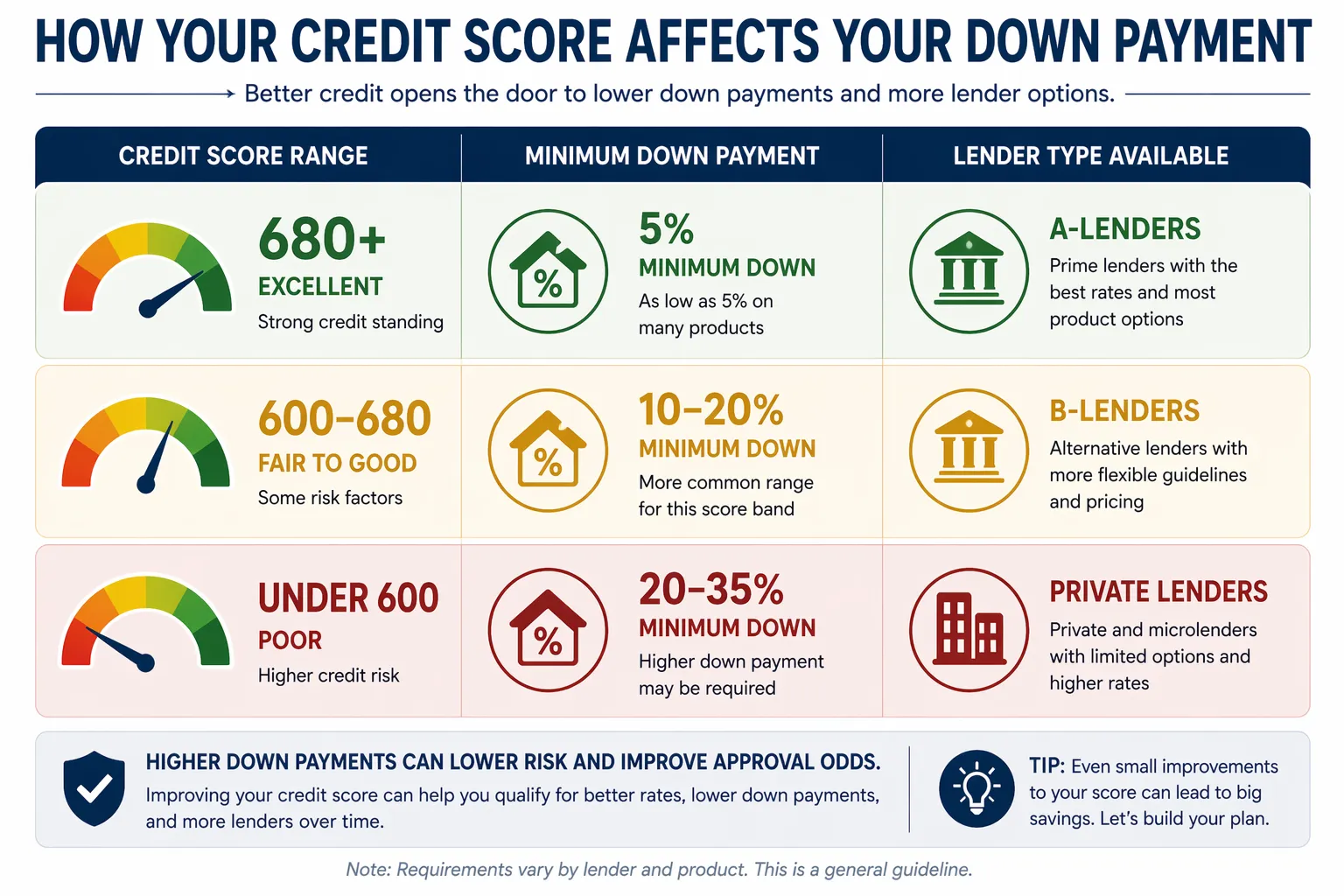
There is no single minimum — it depends on the lender type and your full financial profile. 680+: A lenders at best rates, 5% down. 640–679: most A lenders with standard conditions. 600–639: B lenders and some A lenders with 10–20% down. 560–599: B lenders with 20%+ down. 500–559: B lenders with strong file or private lenders. Below 500: private lenders with 25–35% down.
Credit score is one factor. Income stability, down payment size, and what caused the low score all affect your outcome. A 580 from a medical emergency 2 years ago is treated very differently than a 580 from ongoing missed payments today.
Yes. Private lenders can help immediately post-discharge with 25–35% down. B lenders typically require 1–2 years post-discharge with rebuilt credit and 20% down. A lenders typically require 2 years post-discharge with a 650+ credit score and 24 months of clean credit history.
The clock starts at your discharge date — not your filing date. Start rebuilding immediately with a secured credit card used monthly and paid in full. First-time bankruptcies are treated more favourably than second bankruptcies by most lenders.
Yes. Consumer proposals are viewed more favourably than bankruptcy by most lenders. B lenders can often help during or immediately after a consumer proposal with 20% down — full completion is not always required. A lenders typically require 2 years after completion with a 650+ credit score.
On-time mortgage payments made during a consumer proposal count positively on your Equifax and TransUnion credit files. Alberta homeowners on a consumer proposal have more options than most lenders — or banks — will tell them about.
A B lender mortgage is a mortgage from a regulated Canadian financial institution — such as Home Trust, Equitable Bank, Bridgewater, or CMLS — with more flexible credit and qualification criteria than major banks. B lenders are not payday lenders or loan sharks. They are fully supervised by federal or provincial regulators.
Their rates are typically 1–2% above A lender rates. They are designed as a bridge: qualify now, rebuild credit during the term, then refinance to an A lender at renewal for significantly better rates. This is the standard path for Calgary borrowers with damaged credit.
Yes — but it's temporary. B lender rates are typically 1–2% above bank rates. Private lender rates are typically 6–12%. These reflect the lender's additional risk assessment and are not permanent.
The strategy is to qualify now at the available rate, rebuild credit actively during the term, and refinance to an A lender at renewal. On a $500K mortgage, moving from a B lender at 7% to an A lender at 5% at renewal saves approximately $550/month — over $33,000 over the following 5-year term.
Down payment requirements increase as credit scores decrease. 600+: 10% minimum for most B lenders. 560–600: 20% typically required. Below 560: 25–35% for private lenders.
A larger down payment reduces the lender's risk and can unlock options at higher lender tiers. It also builds equity faster — strengthening your position for A lender refinancing at renewal.
In Alberta: private lenders immediately post-discharge (25–35% down). B lenders: typically 1 year post-discharge with compensating factors and 20%+ down. A lenders: typically 2 years post-discharge with 650+ credit score and 24 months of clean history.
The clock starts at discharge, not filing. First-time bankruptcies are treated more leniently than second bankruptcies. Starting credit rebuilding immediately after discharge — secured credit card, on-time payments — accelerates every timeline above.
A private mortgage is funded by individual investors or Mortgage Investment Corporations (MICs) — not regulated financial institutions. Private lenders are asset-based: they focus on the property value and available equity rather than your credit score or income. Rates are typically 6–12%+.
Private mortgages are a last resort — appropriate when B lenders are not yet an option. Short terms of 6 months to 2 years. An exit strategy to a B or A lender at renewal is non-negotiable before signing. A broker ensures this plan exists before any private mortgage proceeds.
The most effective steps: (1) Get a secured credit card immediately — use monthly, pay in full. (2) Make every mortgage payment on time without exception — this is the single strongest signal. (3) Pay down debts to reduce utilization below 30% of credit limits. (4) Avoid new credit applications during the rebuilding period. (5) Target 640+ credit score before renewal.
With consistent on-time payments over 18–24 months, most borrowers starting in the 560–600 range qualify for A lender rates at renewal. The broker maps your specific timeline at the consultation stage — so you know exactly what to aim for and when.
Other situations we handle across Alberta — each free to clients.
A broker finds the path that works for your situation today — and builds the plan to get you to better rates tomorrow. Free, no judgment, no obligation. 5-star rated and licensed in Alberta.